Persona research and creation to encourage empathy and understanding among engineers and product teams.
Products and features were being discussed and conceived without the user in mind. During brainstorming sessions I noticed that the way the email security product managers and engineers were talking about user facing projects included very few mentions of the actual user. They were speaking about what the product should do and how it should do it, but not what concerns or feelings our users would have. At that time these product teams had not been exposed to utilizing personas in their projects. After a discussion with the other UX team members we decided that creating personas would be a great tool for our engineering and product teams. We hoped that by making these that it would put a face to our users and allow for easier conversations around features and issues.
Advocating for users by creating a tool that product teams and engineers would find useful and enlightening.
I started the persona development process by trying to observe how our engineers and product teams were talking about these projects. I wanted to make sure that I could create personas that would be of value to those teams.
Taking advantage of current user interview sessions allowed me to gather qualitative data.
We were already doing user interviews regularly so the teams collaborated on a short set of questions that could be inserted into the interviews as an icebreaker. While the product manager interviewed the users I took notes. For this first round of persona development I had qualitative data from 10 user interviews. All of the users in this round were IT administrators whom are the audience for the majority of the UI in the products.
Sample Interview Questions
- Describe what your organization does.
- What is your job title?
- How much experience do you have in IT?
- How many years have you worked at your current company?
- How many employees do you have on your current IT team?
- How many email users do you currently have?
- What does your email ecosystem look like? Are you using Office 365 or Exchange On Premise?
- How much time do you spend in the email security product per week?
- What are the primary functions you perform in the email security product when you log in to manage the service?
- Do you utilize any other Barracuda products?
- Are there other security products that you use regularly? If yes what are they and what do you like or dislike about them?
Analysis of the responses allowed me to synthesize the data into three types of users.
I took the responses to the interview questions and was able to bucketize the majority of the responses into three major “kinds” of user. There were some key differences that allowed me to make this distinction.
These differences were:
- Size of the interviewees organization
- Size of their current IT team
- Size of their annual IT budget
It was important to make the personas believable and well rounded.
There were other distinctions that I discovered that could be useful in project discussions and also craft a more well rounded, believable personality profile for the personas.
Examples of some of these were:
- The users IT knowledge
- Ability to experiment with technology
- Technology adoption willingness
- Frustrations they evoked in the interviews
- Goals they had when utilizing the product
I used the Meyers-Briggs test and added photographs to create more convincing characters.
Presenting the personas to product teams and engineers was crucial to aid in the adoption.
After the personas were completed I presented them to the product teams and engineers. They were very excited about this new way of talking about our users and were actually surprised by some of the concerns and needs that our users had. As an example I went through a product spec while applying one of the personas to the user stories and requirements. The product managers felt that these tools provided for a much better flow when brainstorming and coming up with these specifications. Since the engineering teams were already practicing agile development utilizing user stories the personas helped to round out their process in a way that felt more whole.
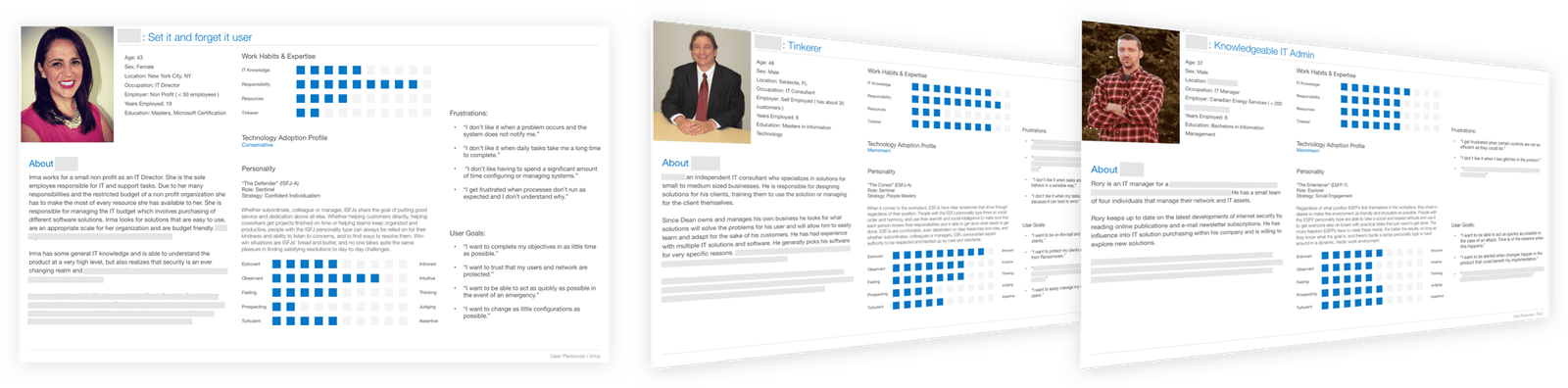
Personas fit into our process with ease and have allowed for more easy brainstorming.
We have continued to use the developed personas in our product meetings. It has become second nature to bring up one of these fictional characters in order to make sure we are taking their concerns and needs into consideration. It makes brainstorming a much more informed feeling discussion. It has also had the affect of reminding out engineers that they are building these products for people and that they aren’t just a line item on a product roadmap.
Personas have changed the way our teams talk about the products and features being built.
Personas have created a much more inclusive process for our product discussions. They have become an invaluable tool in the process. Since we continue to do user interviews I am constantly collecting qualitative data in order to evolve and grow our collection of user personas.